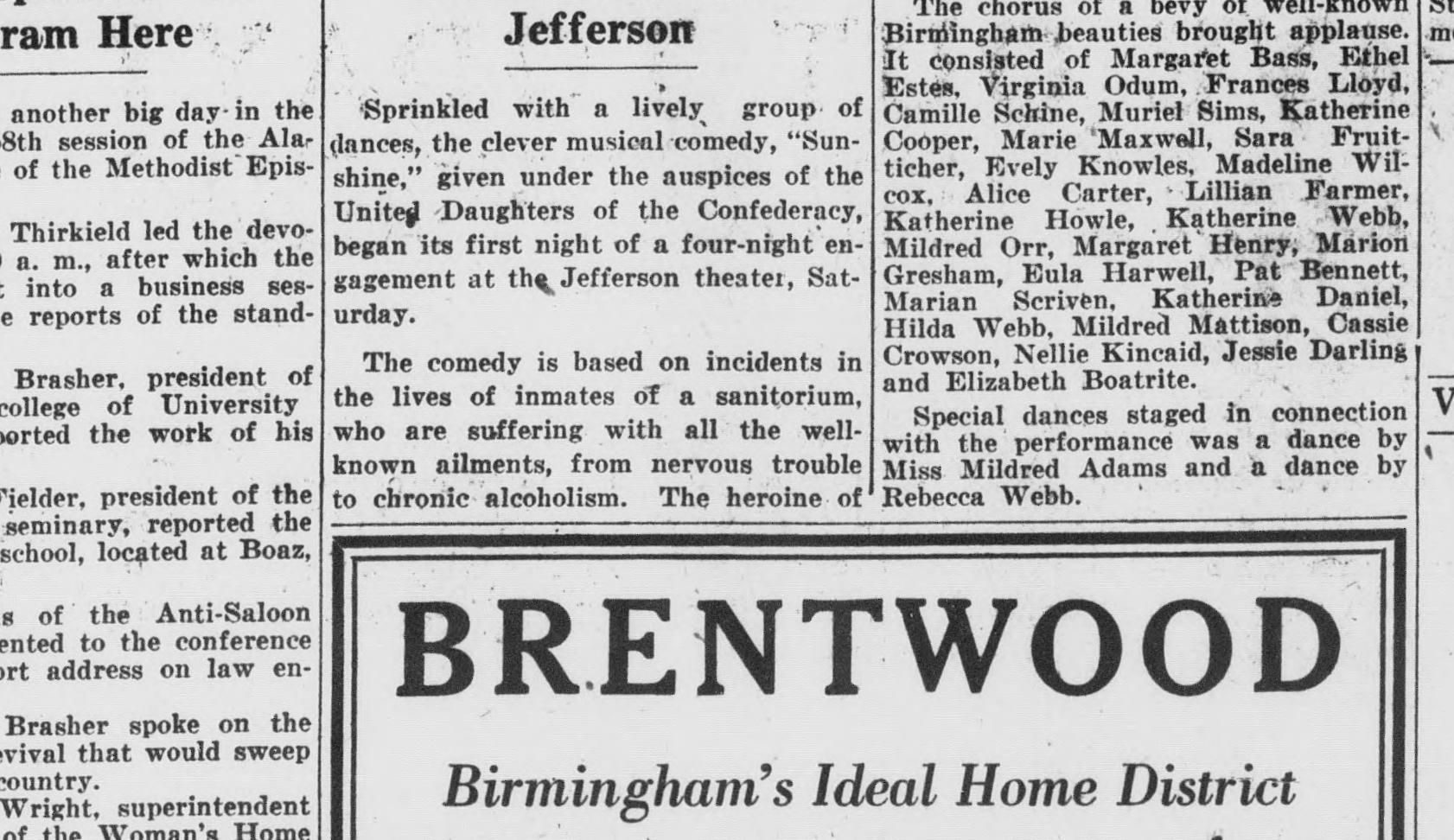
Charles S. Walden, in Texas before independence
Latest discovery, 16 November 2026
Charles S. Walden, later sheriff of Burleson County, Texas, and very probably the son of Charles Sparks Walden of Autauga County, Alabama, came to Texas in February 1835 and was living there when Texas declared its independence on 2 March 1836: so the Washington County Board of Land Commissioners certified in January 1838, granting him as a single man a third of a league. His 1,476 acres were surveyed “on the head waters of First Yegua” in October 1838, and the Republic patented them to him in 1845.
Harris McKinney’s codicil, 1855: a McAdory granddaughter the tree had lost
Found 16 November 2026
Five years after making his will, Harris McKinney of Coosa County, Alabama, added a codicil, signed with his mark on 19 June 1855. He gave his son Patrick “my faithful servant Girl named Eliza & her three children”, gave “my Grand Daughter Robert Celia McAdory a Negro Girl named Ella aged about fifteen years old”, and ordered that all the other people he held in slavery be valued and divided among his heirs. The granddaughter is very probably the Celia McAdory, born in November 1837 just before her father Robert McAdory died, whom the county histories name as the wife of John N. Slaughter of Goodwater; the family tree does not have her, and the codicil is the first original record found to name her.
Harris McKinney · Emily R McKinney McAdory Massingale · Robert McAdory · Patrick McKinney
Harris McKinney’s will, 1850: five children, and a daughter the tree had lost
Found 16 November 2026
Harris McKinney of Coosa County, Alabama, made his will in May 1850, fourteen years before he died. He left his wife Jane the 500-acre home place, his pleasure carriage and ten enslaved people of her own choosing, five men and five women, in place of her dower, and divided the rest among five children: Patrick, Verlinda Thomas, Emily Massengale, Jasper, and the three children of “my Deceased daughter Mary Chappel”, less the thousand dollars he had already given their father. The family tree has no daughter Mary. Nor does the will name the Eli Harris McKinney the tree gives him as a son, which bears out what Eli McKinney’s will showed in November: Webb Wade’s 2nd great-grandfather was Eli’s son, not Harris’s.
Charles Walden’s estate, 1834–1835: two sons the tree had lost
Found 16 November 2026
When Charles Walden’s goods were sold in Autauga County, Alabama, in January 1834, his widow bought back the beds, the loom and the spinning wheels, and three Waldens bid against the neighbours: George S., Alexander, who took the oxen, a mule and the waggon, and “Chas. Sparks Walden”, who paid fifteen dollars for a shotgun. A year later the county court named the heirs who had already had their share in their father’s lifetime: Thomas W., Joseph B., Alexander E. and Charles S. Walden, and Elias Dubose for his wife Martha. Joseph B. and Alexander E. are not in the family tree; with George, John and Westley they make up the “seven sons” a family sketch of 1888 remembered. And the middle name Sparks, which the tree gives Webb Wade’s 3rd great-grandfather, appears in his estate papers only on his son.
Charles Webb’s will and his grave, 1849
Found 16 November 2026
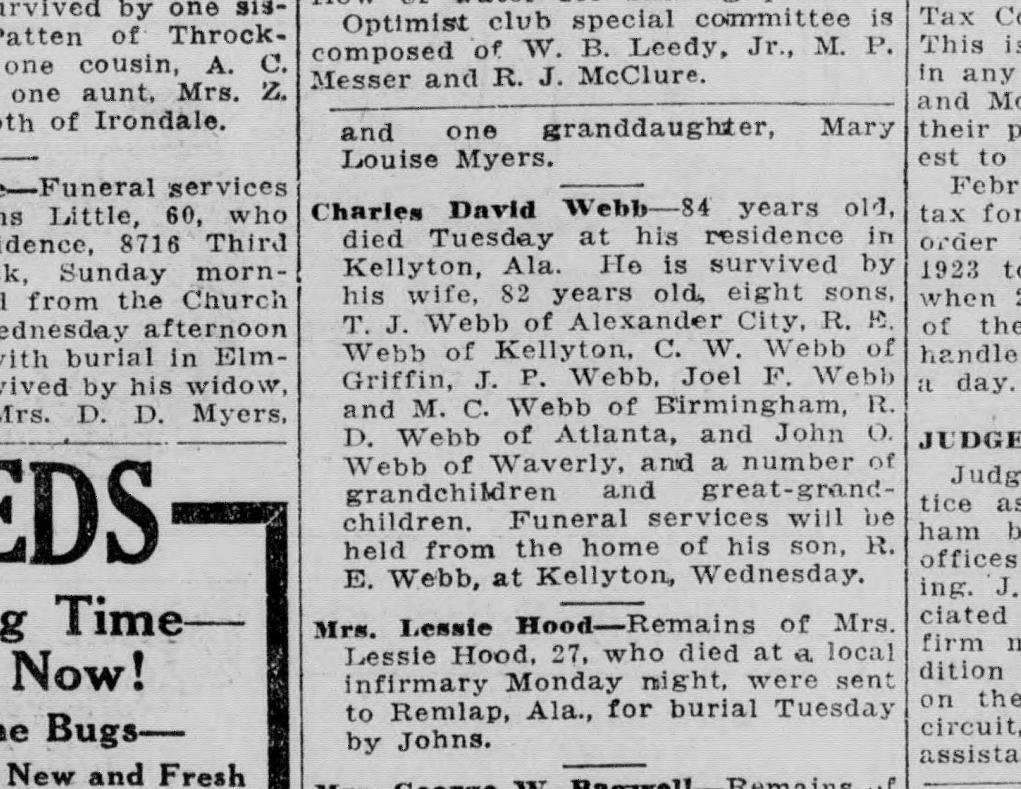
Charles Webb of Monroe County, Georgia, Webb Wade’s 3rd great-grandfather, made his will in January 1849, “feeble of body but of sound and disposing mind”. It gathers his three families into one document: two enslaved people, Cherry, about fifty-two, and Daniel, about thirty-one, to the children of his second marriage, among them Charles H. Webb, Webb Wade’s 2nd great-grandfather; set sums to the children of his first; and her bed and furniture to his third wife, Margaret. That December his executors sold the home place at Forsyth to Charles H. Webb for $745, keeping back “twenty feet square around the grave where Charles Webb is buried”: very probably the small fenced Webb Cemetery at Blount that stands on private land today.
Edmund Carlisle’s will, 1828: nine children and a plan to move west
Found 16 November 2026
Edmund Carlisle of Morgan County, Georgia, Webb Wade’s 3rd great-grandfather, made his will at the end of April 1828. He left his wife Elizabeth their 220-acre home and five enslaved people, Mark, Sarah, Patt, Jule and Seller, to raise and educate the children still at home; named seven children to share the estate, among them Robert (“Robin W.”), Webb Wade’s 2nd great-grandfather; cut off two married daughters with five dollars paid to their husbands; and asked that his grandson Joseph be kept at school until he could read, write and do arithmetic “to the rule of three”. He even allowed for the family to sell up and “carry the family to the Chatahoochy”, the new country to the west where his sons later settled. The will was proved in May 1830. It also shows that the family tree’s date for his death, 13 April 1828, is too early: that is the index’s reading of the will’s own date.
Edmund Carlile · Elizabeth Ann Whatley · Robert Whatley Carlisle
John Wade, silk dyer of Gold Street
Found 16 November 2026
Eliza Ann Wade always said she was born in Gold Street, New York City, in 1816. The city directories show what her father did there: in 1820 “Wade John, silk dyer 74 Gold”. Three years earlier an Edward Wade, dyer, was at the same house while John dyed silk in William Street, and in 1800 an Edward Wade junior was already a silk dyer in Rutgers Street. A family history of 1902 names an Edward Wade, who came from England about 1800, as the founder of the family in America; the directories suggest that he and John Wade shared a silk-dyeing business, though they never say how the two men were related.
John N. Owens’s will, and his son-in-law’s contest
Found 16 November 2026
In December 1854 John N. Owens of Tallapoosa County, Alabama, made a will that left five dollars apiece to the six children of his first marriage, among them “my daughter Clarissa M. Carlisle”, Webb Wade’s 2nd great-grandmother, and the rest of his property to his second wife Nancy and her “four youngest children”, the Orrs. After his death Clarissa’s husband, Robert W. Carlisle, led the heirs who contested it; the case was moved to the Chambers County court, where a jury upheld the will in September 1861 and no appeal was taken.
John N Owens · Clarissa Ann Mitchell Owens · Robert Whatley Carlisle
Alban Willingham’s heirs, 1858: Martha McKinney among his daughters
Found 16 November 2026
When Alban Willingham died in Coosa County, Alabama, in 1858, his widow Susan gave up her dower for a child’s share “to bring about a Speedy & quiet Settlement” of his estate, and the county’s deed record names the heirs she made the bargain with: three sons, Shimie, Roberson and Alban, and five daughters by their husbands’ names, among them “Harris McKinney & his wife Martha McKinney formerly Martha Willingham”. It is the first record found that names Webb Wade’s 2nd great-grandmother Martha as Alban Willingham’s daughter; until now her parentage rested on the family tree and her daughter’s death certificate.
Alban W. Willingham · Martha Holland Willingham · Eli Harris McKinney Sr.
Charles S. Walden, sheriff of Burleson County
Found 15 November 2026
Charles S. Walden, Webb Wade’s 2nd great-granduncle, who died in Burleson County, Texas, by May 1853, was the county’s sheriff from at least August 1848, when a writ “Came to hand” to “Charles S. Walden Shff of Burleson County”, to at least February 1852, when he sold a debtor’s land at the court house in Caldwell by a deed beginning “I, C. S. Walden Sheriff of the County of Burleson”. The district court of neighbouring Washington County copied its writs and the sheriffs’ returns into its record book, and two of 1850 are addressed “To the Sheriff of Burleson County” and carry his return, “C. S. Walden Sheriff B.C.”: one received on 23 April 1850, whose man was “Not found”, and one received on 23 September and “Executed October first 1850”.
Also found lately
- 16 November 2026 Charles S. Walden, in Texas before independence
- 16 November 2026 Harris McKinney’s codicil, 1855: a McAdory granddaughter the tree had lost
- 16 November 2026 Harris McKinney’s will, 1850: five children, and a daughter the tree had lost
- 16 November 2026 Charles Walden’s estate, 1834–1835: two sons the tree had lost
- 16 November 2026 Charles Webb’s will and his grave, 1849
- 16 November 2026 Edmund Carlisle’s will, 1828: nine children and a plan to move west
- 16 November 2026 John Wade, silk dyer of Gold Street
- 16 November 2026 John N. Owens’s will, and his son-in-law’s contest
- 16 November 2026 Alban Willingham’s heirs, 1858: Martha McKinney among his daughters
- 15 November 2026 Charles S. Walden, sheriff of Burleson County